Friday, February 12, 2021

"Ephphatha" - "Be opened


Ephphatha - Be opened
I am providing the readings of today Feb 12, 2021 below. The first reading is important because it opens us up to the reflection and then the question: We are going to be opening ourselves up to someone, so just who are you listening to today? The reflection follows the readings.

Reading I Gn 3:1-8

Now the serpent was the most cunning of all the animals that the LORD God had made.

The serpent asked the woman, “Did God really tell you not to eat from any of the trees in the garden?”
The woman answered the serpent: “We may eat of the fruit of the trees in the garden; it is only about the fruit of the tree in the middle of the garden that God said, ‘You shall not eat it or even touch it, lest you die.’”

But the serpent said to the woman: “You certainly will not die! No, God knows well that the moment you eat of it your eyes will be opened and you will be like gods who know what is good and what is evil.” The woman saw that the tree was good for food, pleasing to the eyes, and desirable for gaining wisdom. So she took some of its fruit and ate it;

and she also gave some to her husband, who was with her, and he ate it. Then the eyes of both of them were opened, and they realized that they were naked; so they sewed fig leaves together and made loincloths for themselves.

When they heard the sound of the LORD God moving about in the garden at the breezy time of the day, the man and his wife hid themselves from the LORD God among the trees of the garden.


Gospel

Mk 7:31-37

Jesus left the district of Tyre and went by way of Sidon to the Sea of Galilee, into the district of the Decapolis. And people brought to him a deaf man who had a speech impediment and begged him to lay his hand on him. 

He took him off by himself away from the crowd. He put his finger into the man’s ears and, spitting, touched his tongue; then he looked up to heaven and groaned, and said to him,

Ephphatha!” (that is, “Be opened!”)

And immediately the man’s ears were opened, his speech impediment was removed, and he spoke plainly. 
He ordered them not to tell anyone.  But the more he ordered them not to, the more they proclaimed it. They were exceedingly astonished and they said, “He has done all things well. 
He makes the deaf hear and the mute speak.”

______________________________________________________

Pope Benedict XVI reflection

“There is not only a physical deafness which largely cuts people off from social life; there is also a "hardness of hearing" where God is concerned, and this is something from which we particularly suffer in our own time. Put simply, we are no longer able to hear God - there are too many different frequencies filling our ears. What is said about God strikes us as pre-scientific, no longer suited to our age. Along with this hardness of hearing or outright deafness where God is concerned, we naturally lose our ability to speak with him and to him. And so we end up losing a decisive capacity for perception. We risk losing our inner senses. This weakening of our capacity for perception drastically and dangerously curtails the range of our relationship with reality in general. The horizon of our life is disturbingly foreshortened...

“The Gospel tells us that Jesus put his fingers in the ears of the deaf-mute, touched the sick man's tongue with spittle and said "Ephphatha" - "Be opened". The Evangelist has preserved for us the original Aramaic word which Jesus spoke, and thus he brings us back to that very moment. What happened then was unique, but it does not belong to a distant past: Jesus continues to do the same thing anew, even today. At our Baptism he touched each of us and said "Ephphatha" - "Be opened" -, thus enabling us to hear God's voice and to be able to talk to him...


“The Gospel invites us to realize that we have a "deficit" in our capacity for perception - initially, we do not notice this deficiency as such, since everything else seems so urgent and logical; since everything seems to proceed normally, even when we no longer have eyes and ears for God and we live without him. But is it true that everything goes on as usual when God no longer is a part of our lives and our world?


“As we gather here, let us here ask the Lord with all our hearts to speak anew his "Ephphatha", to heal our hardness of hearing for God's presence, activity and word, and to give us sight and hearing. Let us ask his help in rediscovering prayer, to which he invites us in the liturgy and whose essential formula he has taught us in the Our Father.” - HIS HOLINESS BENEDICT XVI 

Wednesday, February 10, 2021

Trying to Understand the Human Person Better

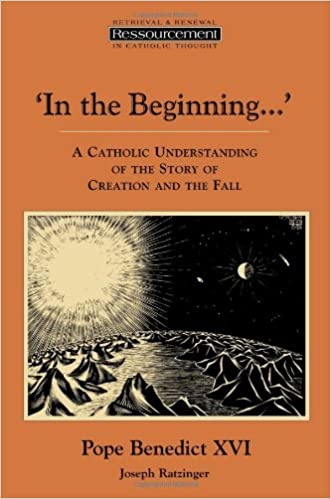
 In the Beginning…' Pope Benedict XVI

In a Lenten sermon given in 1981 in the cathedral of Munich, Germany, “Cardinal” Joseph Ratzinger said the following:


“In the Genesis story that we are considering, still a further characteristic of sin is described. Sin is not spoken of in general as an abstract possibility but as a deed, as the sin of a particular person, Adam, who stands at the origin of humankind and with whom the history of sin begins. The account tells us that sin begets sin, and that therefore all the sins of history are interlinked. Theology refers to this state of affairs by the certainly misleading and imprecise term ‘original sin.’ What does this mean? Nothing seems to us today to be stranger or, indeed, more absurd than to insist upon original sin, since, according to our way of thinking, guilt can only be something very personal, and since God does not run a concentration camp, in which one’s relative are imprisoned, because he is a liberating God of love, who calls each one by name. What does original sin mean, then, when we interpret it correctly?

“Finding an answer to this requires nothing less than trying to understand the human person better. It must once again be stressed that no human being is closed in upon himself or herself and that no one can live of/or for himself or herself alone. We receive our life not only at the moment of birth but every day from without–from others who are not ourselves but who nonetheless somehow pertain to us. Human beings have their selves not only in themselves but also outside of themselves: they live in those whom they love and in those who love them and to whom they are ‘present.’ Human beings are relational, and they possess their lives–themselves–only by way of relationship. I alone am not myself, but only in and with you am I myself. To be truly a human being means to be related in love, to be of and for. But sin means the damaging or the destruction of relationality. Sin is a rejection of relationality because it wants to make the human being a god. Sin is loss of relationship, disturbance of relationship, and therefore it is not restricted to the individual. When I destroy a relationship, then this event–sin–touches the other person involved in the relationship. Consequently sin is always an offense that touches others, that alters the world and damages it. To the extent that this is true, when the network of human relationships is damaged from the very beginning, then every human being enters into a world that is marked by relational damage. At the very moment that a person begins human existence, which is a good, he or she is confronted by a sin-damaged world. Each of us enters into a situation in which relationality has been hurt. Consequently each person is, from the very start, damaged in relationships and does not engage in them as he or she ought. Sin pursues the human being, and he or she capitulates to it.”

(Joseph Cardinal Ratzinger, ‘In the Beginning…’: A Catholic Understanding of the Story of Creation and the Fall, trans. Boniface Ramsey, OP [Eerdmans, 1995], pp. 71-73)


Also see:

BENEDICT XVI GENERAL AUDIENCE Paul VI Audience Hall Wednesday, 6 February 2013

Actually, in opposing their Creator people go against themselves, deny their origin and consequently their truth; and evil, with its painful chain of sorrow and death, enters the world. Moreover, all that God had created was good, indeed, very good, but after man had opted freely for falsehood rather than truth, evil entered the world.

I would like to highlight a final teaching in the accounts of the Creation; sin begets sin and all the sins of history are interconnected. This aspect impels us to speak of what is called “original sin”. What is the meaning of this reality that is not easy to understand? I would just like to suggest a few points. First of all we must consider that no human being is closed in on himself, no one can live solely for himself and by himself; we receive life from the other and not only at the moment of our birth but every day. Being human is a relationship: I am myself only in the “you” and through the “you”, in the relationship of love with the “you” of God and the “you” of others. Well, sin is the distortion or destruction of the relationship with God, this is its essence: it ruins the relationship with God, the fundamental relationship, by putting ourselves in God’s place.


Wednesday, January 20, 2021

Opportunity to be Patient


Enjoy this video clip from the movie, Evan Almighty, where the waiter, Al Mighty, played by Morgan Freeman, explains prayer as, 'God providing opportunities'. What are we going to do with the opportunities in our life?

·         Joan: Excuse me. Can I get a refill please? 


·         God: Coming right up. 


·         Joan: Thank you. 


·         God: Excuse me. Are you alright? 


·         Joan: Yeah. (God looks at her unconvinced.) No. It’s a long story. 


·         God: Well, I like stories. I’m considered a bit of a storyteller myself. 


·         Joan: My husband… Have you heard of New York’s Noah? 


·         God: (Chuckling) The guy who’s building the ark. 


·         Joan: That’s him. 


·         God: I love that story, Noah and the Ark. You know, a lot of people miss the point of that story. They think it’s about God’s wrath and anger. They love it when God gets angry. 


·         Joan: What is the story about, then? The ark? 


·         God: Well, I think it’s a love story about believing in each other. You know, the animals showed up in pairs. They stood by each other, side by side, just like Noah and his family. Everybody entered the ark side by side. 


·         Joan: But my husband says God told him to do it. What do you do with that? 


·         God: Sounds like an opportunity. Let me ask you something. If someone prays for patience, do you think God gives them patience? Or does he give them the opportunity to be patient? If they pray for courage, does God give them courage, or does he give them opportunities to be courageous? If someone prayed for their family to be closer, you think God zaps them with warm, fuzzy feelings? Or does he give them opportunities to love each other? Well, I got to run, a lot of people to serve. Enjoy. 


Friday, January 15, 2021

Neighours (1952) - A Film by Norman McLaren


Erik Buys writes in his blog, Mimetic Margins:

In 1952, Scottish-born Canadian film director and animator Norman McLaren (1914-1987) released his hugely acclaimed short film Neighbours. It won both a Canadian Film Award and an Academy Award, and has been designated as a ‘masterwork’ by the Audio-Visual Preservation Trust of Canada. Moreover, in 2009, the film was added to UNESCO’s Memory of the World Programme. Neighbours is a revolutionary piece of art, both in content and in style. McLaren is a master in using the so-called pixilation, an animation technique which treats live actors as stop-motion objects. As for the content, Neighbours can be considered an anti-war statement. 

Asked about the inspiration for his film, McLaren answered: I was inspired to make Neighbours by a stay of almost a year in the People’s Republic of China. Although I only saw the beginnings of Mao’s revolution, my faith in human nature was reinvigorated by it. Then I came back to Quebec and the Korean War began. My sympathies were divided at that time. I felt myself to be as close to the Chinese people as I felt proud of my status as a Canadian. I decided to make a really strong film about anti-militarism and against war.”

The film clearly demonstrates the mimetic origin of rivalry and its escalation into violence. Two neighbours, living together peacefully and enjoying shared interests, become each other’s rivals once they both lay claim on a flower. The film plainly depicts they not only pay attention to this object, but also that they increasingly keep an eye on each other until, finally, the attention for the object completely disappears. As they imitate each other’s claims and try to manifest themselves over against one another, the object is even destroyed during the process.

Neighbours not only ironically reveals that one’s desire for prestige, pride and power is actually based on nothing (but an imitation of another’s desire), but it also shows the tragic and horrifying, shocking outcome of escalated mimetic rivalry. The former friends are tricked into becoming each other’s monstrous doubles. The Latin word praestigia means deception or illusion and it indeed points to the misleading nature of mimetic desire.

Tuesday, December 29, 2020

We Were Created to be Listeners


To "listen" another's soul into a condition of disclosure and discovery may be almost the greatest service that any human being ever performs for another. But in this scrutiny of the business of listening, is that all that has emerged? Is it blasphemous to suggest that over the shoulder of the human listener, there is never absent the silent presence of the Eternal Listener, the living God? For in penetrating to what is involved in listening, do we not disclose the thinness of the filament that separates person listening openly to one another, and that of God intently listening to each soul?

~ from GLEANINGS by Douglas V. Steere

Saturday, July 11, 2020

There is Only One Sadness - Not to Live in God's Desire for Life Abundantly

No more sadness...
For me life seems to present more meaning as I have been processing through the death of my mom. She passed away almost 2 months ago and I continue to find more joy in living fully knowing of God's Eternal Life to come.

From the Magnificat Meditation of the Day 

Faced with death, shall I be afraid? Ought I to be afraid? It seems to me, no. Well or ill, I have done what I could to keep on the track of my destiny. My eternal future is in the hands of God, I abandon myself to my heavenly Father. I shall go to Christ, that will be deliverance. I have a peaceful feeling about it. The Lord knows what I have suffered. If ever I felt the “comfort” of the spiritual life, that feeling has long ago left me. A spiritual destiny is a light bridge thrown across the abyss, or the peak of a rock rising above the ocean. If the bridge and the rock are proof against all hazards, the soul does not know it. She has a view of the world that makes her dizzy, whether it displays itself to her in its beauty or its madness. Because she is separated but not yet withdrawn from the world. The beauty, the intelligible consistence, the nobility, the justice of the divine world from which she receives life are essentially objects of faith. She lives by secret motions. The object of her love is veiled….

The divine Scriptures awaken in my soul the desire to see God; the desire to depart for eternal life. It is a desire which springs from the joy of the soul—and not from the sadness of temporal life. I love this daily life too and I love my beloved Jacques and [my sister] Véra and I love our friends, and all beauty: but perhaps God is beginning to call my soul and to train it to the hope of eternal life. At these moments of living faith and joy, the fear of God frightens me less. Sweet Jesus, have pity on me.
Raïssa Maritain
Raïssa Maritain († 1960) was born in Russia. She was a convert to Catholicism and the wife of philosopher Jacques Maritain. [From Raïssa’s Journal, presented by Jacques Maritain. © 1974, Magi Books, Inc., Albany, NY. All rights reserved.]
I found solace in these remarks and, when searching for more information on Raissa and Jacques Maritain, I stumbled onto Rabbi Mark Kinzer / Congregation Zera Avraham, as he describes with beautiful detail the impact of one, on the way to becoming a saint, and how his life made an indelible imprint on the lives of Raissa and Jacques Maritain HERE.  (An excerpt from his remarks.)
Jacques and Raissa were not your typical students. They thought and felt deeply about everything. They realized what this worldview implied about life: in the final analysis, all was meaningless. Truth, goodness, beauty were illusions. There was nothing worth living for – and so they were considering leaving life itself behind, and doing it together on their own terms. Then they read a book that changed everything. It was a novel by a devout Christian by the name of Leon Bloy. The final line of the novel took their breath away, and became a motto for their future life together: “There is only one sadness – not to be a saint.  
Imagine living life fully and unreservedly, fulling the purpose we were created for and knowing the treasure is Eternal Life in God.

Friday, June 12, 2020

The Real Presence Requires the Sacrament and the Church

ENCOUNTERING CHRIST IN THE EUCHARIST


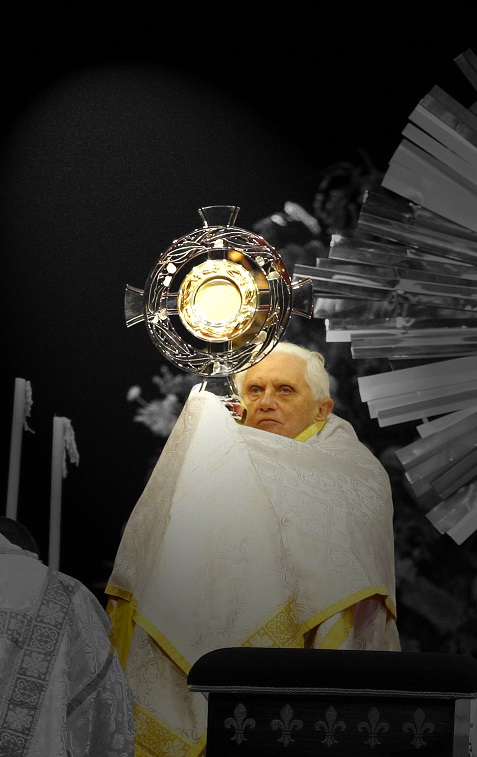
We need the living Christ, whom we can know only through our encounter with him. But encounter presumes actual presence—the Real Presence, which, in turn, requires the Sacrament and the Church that alone is authorized to give us the Sacrament, the Church that Christ himself willed into existence and continues to support. The Eucharist, at each new celebration, must be recognized anew as the core of our Christian life. But we cannot celebrate the Eucharist adequately if we are content to reduce it to a ritual of—more or less—a half-hour’s duration. To receive Christ means to worship him. We welcome him properly and worthily at the solemn moment of receiving him only when we worship him and in worshiping him learn to know him, come to understand his nature, and follow him. We need to learn once more how to rest peacefully in his gentle presence in our churches, where the Eucharist is likewise always present because Christ intercedes for us before the Father, because he always awaits us and speaks to us. We must learn again how to draw inwardly close to him, for it is only thus that we become worthy of the Eucharist. We cannot prepare ourselves to receive the Eucharist simply by thinking about how it should be done. We can prepare for it only when we try to comprehend the depths of its demands on us, of its greatness; when we do not reduce it to our level, but let ourselves be raised to its exalted level; when we become aware of the accumulated sound of the prayers offered during all the centuries in which generations of men have advanced and are still advancing toward Christ. It is petty and undiscerning to criticize such prayers because we do not understand them; it is an expression of a genuinely “critical” sentiment (of which, be it noted, self-criticism is also a form) when we begin to recognize their greatness and, opening ourselves to that greatness, let ourselves be deepened and purified by it.
From: Joseph Ratzinger, Roman homilies, October 12, 1982